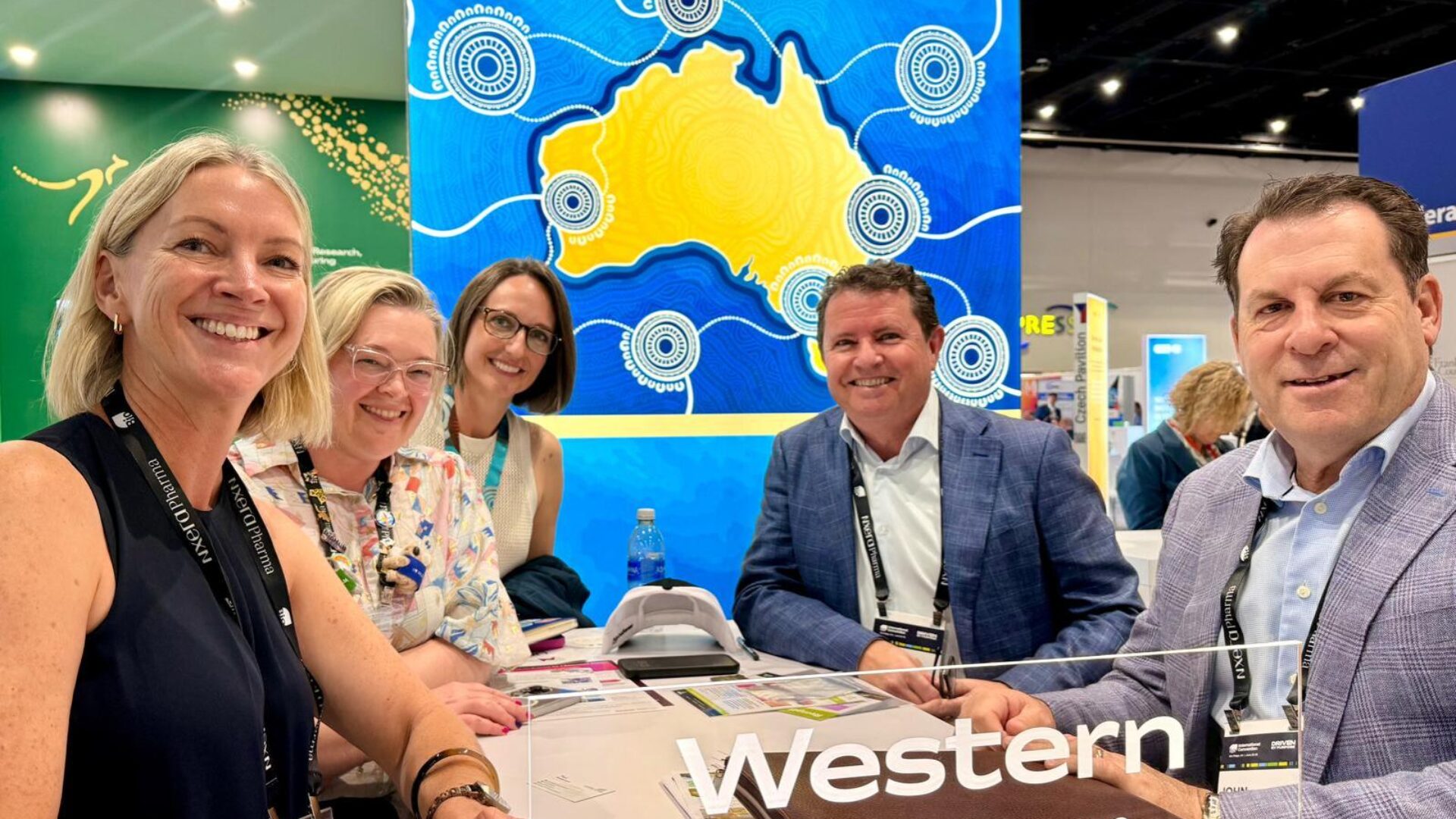
Blog by Dr Tracey Wilkinson, AUScelerate Director Stakeholder Engagement, WA and National & WA Life Sciences Innovation Hub
I must have repeated this fact multiple times a day during my time in San Diego, attending the annual BIO International Convention, and even most Americans were astonished.
That single number captures why it’s worth an Australian travelling over 15,000 kms to be in the US. The US remains the biggest and most important market for biotech, but real-world understanding of any market is best gained from time on the ground, in person.
Part of AUScelerate’s national team, I was focussed on supporting Western Australian companies and promoting opportunities across the state’s biotech sector as part of my role in the WA Life Sciences Innovation Hub. International conference delegations like BIO are an efficient, effective solution to overcome the barrier of geography, and part of the reason why the Australian contingent is consistently one of the largest international delegations to attend.
BIO 2026 returned to San Diego for the third time since 2022, but there are always new insights to take home. Here are my takeaways from the concentrated, intense melting pot that is BIO – across AUScelerate’s site visit program, presentations and countless conversations on the conference floor.
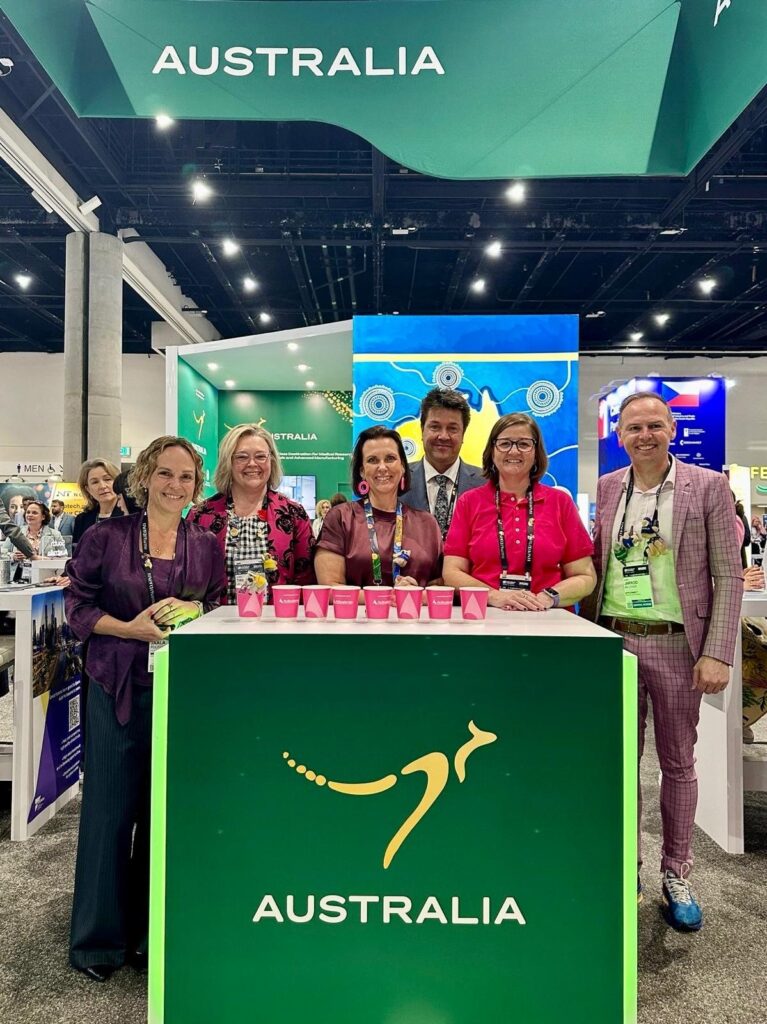
Dr Tracey Wilkinson with the AUScelerate team at the Australian Pavilion at BIO 2026
The visibility problem isn’t just ours
Despite that huge economic contribution, Biocom, the California life sciences association, still has to work hard to raise awareness of the sector’s value and importance. Given recent developments in Australia around taxation policy, this resonated deeply. In my home state of Western Australia, the economy is dominated by resources, and we talk about this challenge constantly. Learning that even a giant like California faces the same battle was reassuring and seeing how Biocom tackles it, with clear messages backed by hard data, was instructive.
AUScelerate has a strategic partnership with Biocom, who kicked off our site visit program with a presentation and Q&A. Biocom represents 1,800 life sciences companies in California, and their Senior Vice President and Chief Policy Officer, Jimmy Jackson, generously shared two decades of hard-won knowledge.
A few things stood out.
AI: enormous ambition, limited payoff (so far)
The sentiment around AI was fascinating. Most industry leaders see it as a driver of growth — but few are confident of success, and the numbers tell the story:
Everyone’s rushing in; few are winning yet. The appetite for AI capability building is strong, even in the state that’s home to Silicon Valley and NVIDIA, the world’s most valuable company whose products power global AI.
That theme followed us onto the site visits. At Nucleus Biologics, a cell culture media manufacturer, AI is being built into a platform to enable customisation (a long way from their first product, which used bovine serum sourced from Australia!). And in a highly engaged Q&A with ResMed leadership, CEO Mick Farrell, CMO Dr Carlos Nunez and Global General Counsel Mike Rider, we heard how the company has transformed from a hardware business making masks into a connected digital health company focused on sleep.
ResMed’s 30 billion nights of sleep data is the largest sleep dataset in the world, and a genuine competitive advantage, one they will never sell. It’s a powerful reminder of the critical importance of a data strategy. My favourite insight: their data and research has been instrumental in proving that ResMed’s devices are synergistic with GLP-1 treatments, not replaced by them. Underpinning it all is a culture of continuous improvement and a focus on research that keeps producing better devices and better patient outcomes. This conversation was one of my personal highlights of the trip – I took pages of notes!
Is the ‘biotech winter over?
The investment outlook was more positive than in recent years, with a significant uptick in VC activity in 2026 leaving some convinced the ‘biotech winter’ is over.
However, Alexandria Ventures®, who build, operate and manage biotech infrastructure around major clusters and whose venture arm is one of the most active life science investors in the US, confirmed a continuing trend: fewer rounds but larger deals. Bigger seed and Series A rounds are driving a faster emergence of scaling private companies. San Diego, it turns out, has the highest concentration of venture funding into life sciences in the US and is the top biopharma M&A market.
That said, policy and regulatory uncertainty across the US remains a key barrier to investor confidence. Raising capital is not easy right now, with stiff competition from AI, energy and space.
What’s striking about San Diego is the positive fly-wheel effect: founders and entrepreneurs stay in the ecosystem, supporting and reinvesting in early-stage opportunities. Groups like Aquillius Ventures are pioneering a dual-purpose model of profit and social impact, with an innovation hub offering expert resources, coworking space and capital. Their hands-on, practical approach to incubating companies was obvious from the energy in the room during our visit to their facility.
The secret ingredient? A 22-minute commute
I already knew San Diego was a world-class biotech ecosystem, but understanding why is always illuminating. Two things stood out: ecosystem density and lifestyle.
Co-locating research, big pharma, start-ups and investors makes collaboration easy. But San Diego’s real differentiator is lifestyle. It promotes itself as a place people want to move to and stay. That’s not just money and opportunity; it’s sunshine, beaches and an average commute of just 22 minutes. On our sneak-peek visit to Invetech‘s brand-new facility, a staff member told me how much he loved starting his day with a ride to work through the San Diego hills on his mountain bike. A good reminder of how much the ‘small’ things matter and how much more we could promote Australia’s enviable lifestyle to attract the highly skilled professionals our biotech sector needs for success. And a shout-out to Trade and Invest Queensland for the massive banner outside the exhibition hall, showing off Queensland’s natural beauty to delegates every day during BIO.
Given my interest in growing the Western Australian ecosystem, through the WA Life Sciences Innovation Hub, and the infrastructure investments happening in Perth, I was especially drawn to how ecosystem design is evolving. Instead of a closed, isolated ‘fortress campus’, the new model is an ‘innovation ecosystem’: multi-tenant, walkable, close to research organisations. It doesn’t just improve collaboration – it attracts and retains talent, deepens engagement and connection and lifts productivity. A win-win-win situation.
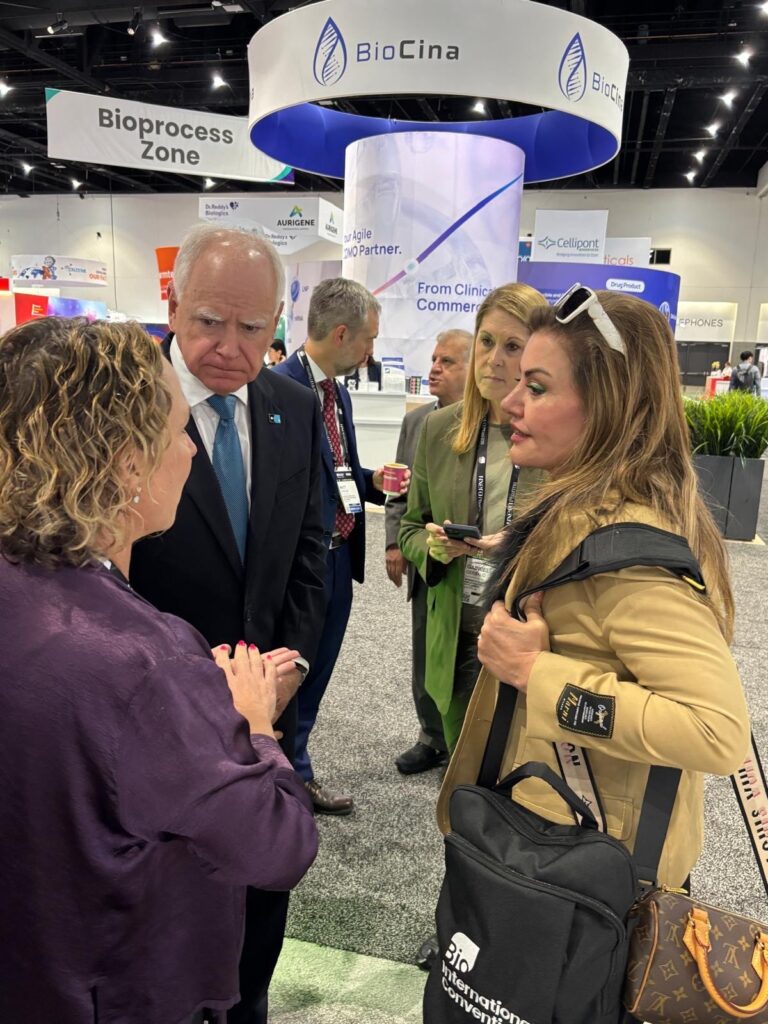
AUScelerate Board Chair Hon Jaala Pulford introduces Smartfem Founder Dr Behnia-Willison to Minnesota Governor Tim Walz
Relationships are infrastructure
People remain the most critical part of any strong, lasting ecosystem. The University of California San Diego’s role in developing high-quality graduates and its willingness to work with industry was a reminder that the importance of the connection between academia and industry can’t be overstated.
The value of partnerships was reinforced again and again at BIO. Relationships between global ecosystems are the intangible infrastructure that links innovators to global opportunities, like AUScelerate’s long-standing partnership with healthcare network Medical Alley, which connects Australia and Minnesota’s medtech epicentre; and similar partnerships with Biocom, Korea Health Industry Development Institute and the Kingdom of Saudi Arabia, which saw high-profile international visitors hosted by AUScelerate at BIO to connect with Australians.
Just one example highlighting the value of this infrastructure is Dr Fariba Behnia-Willison, a clinician-founder from Adelaide. Her company, Smartfem, has advanced through pivotal connections into Minnesota made by AUScelerate’s South Australian team, including an invitation to the Mayo Clinic’s Beahrs Surgical Innovation Summit. Smartfem is now establishing an office in Minneapolis to access the US market. It was a pleasure to witness AUScelerate Chair, Hon Jaala Pulford introduce Dr Behnia-Willison to Minnesota Governor Tim Walz when AUScelerate hosted him at the Australian pavilion during BIO. Dr Behnia-Willison was also a guest speaker at our sold-out 4th Women in Life Sciences Leadership breakfast, generously sponsored by Moderna Australia. Fittingly, this year’s event, the brainchild of my AUScelerate colleague Dana Bell and US-based executive and angel investor Kate Liebelt, was all about how to activate your network.
I left BIO 2026 with over-worked vocal cords and a renewed appreciation for the global love of clip-on koalas, stuffed quokkas, and, of course, Bluey. Most importantly for a business built on relationships, I was reminded once again of the value of a good conversation: to build connection, awareness and understanding.
If you’re a medtech executive feeling a little left out reading this – good news! There’s still time to join AUScelerate’s medtech US trade mission, 14-21 October 2026 to Boston and New York. Because in the end, success in any market comes down to people and relationships.


